Choosing what is the best air filter for mining operations begins with the dust, not the product label. A filter facing silica-rich cutting dust may need different media and maintenance than one handling haul-road particles or diesel soot. John A. Organiscak, a NIOSH mining researcher whose work examines mine dust control, offers a useful evidence-based takeaway: his research supports evaluating controls by their measured performance in real working conditions, rather than relying on claims alone. This is a paraphrase, not a direct quotation.
Dust settles everywhere. It coats cab seals, clogs intake grilles, and loads filter media faster than a clean-site test may suggest. The right choice depends on particle size, airflow, equipment design, service intervals, and the people the system protects. A high-efficiency filter can still disappoint if it is poorly fitted or replaced too late. That matters.
This Top 10 guide compares air-filter options for mining operations by filtration performance, durability, compatibility, and practical upkeep. It also considers operating costs and the limits of product specifications. No single filter suits every mine. Conditions change between a wet tunnel, a dry crushing area, and a mobile equipment cab. The comparison can narrow the field, but site measurements and qualified occupational-hygiene advice should guide the final choice. A ranking is useful; it is not a substitute for testing.
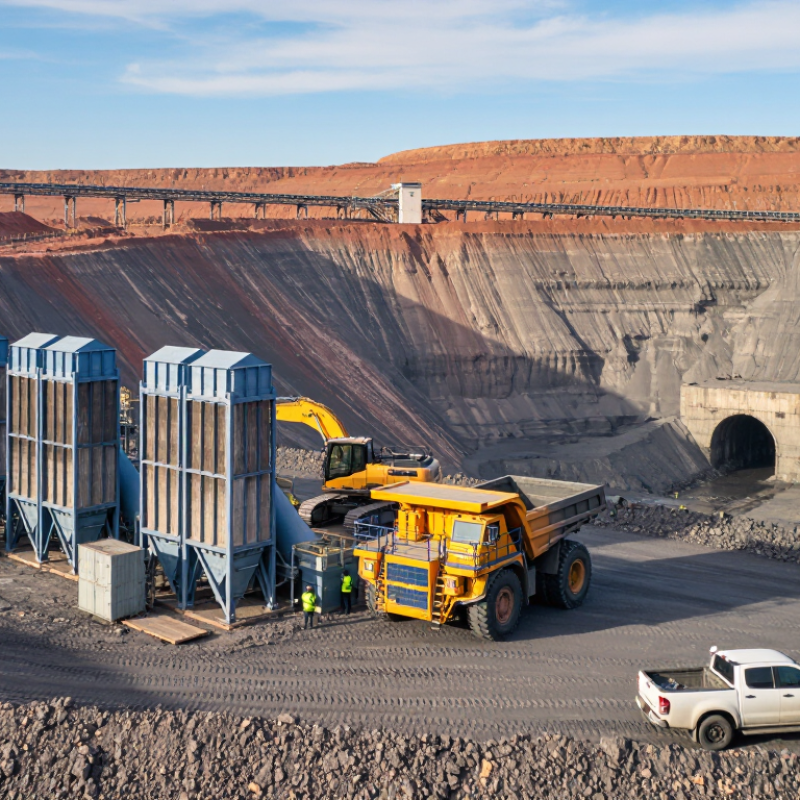
Mining air rarely contains just one kind of dust. Drilling and crushing can release fine mineral particles, including respirable crystalline silica, while diesel equipment adds soot and other exhaust particles. The mix varies. Moisture, ore type, and airflow can also change how dust travels through a work area.
A suitable filtration system must match the contaminant, particle size, and required airflow. High-efficiency media may capture fine particles, but only when the housing seals properly and the system maintains adequate airflow. Pressure drop matters: as filters load with dust, airflow can fall, leaving workers exposed even when equipment is running. Check manufacturer test data and system specifications rather than relying on a filter label alone.
Good filtration starts with reducing dust at its source, using enclosure, extraction, and ventilation where practical. Then inspect filters for damage, poor seals, and uneven dust buildup. Record pressure readings and replacement dates; a clean-looking filter can still be clogged. Dust sampling can help confirm whether controls are working, though results may vary with shift conditions and sampling locations. Maintenance records are useful, but they do not replace exposure checks. One weak point is often overlooked: a well-chosen filter cannot compensate for a leaking duct or neglected housing.
Air in a mine can shift from fine mineral dust to coarse debris within a single shift. Workers may notice haze near a transfer point, while operators see little change at the intake. Evaluate each filter against the site’s dust profile, not a generic label. Ask for test data across relevant particle sizes and airflow rates.
Efficiency matters, but so does resistance to airflow. A filter that captures fine particles yet quickly restricts ventilation may create operational problems. Compare pressure drop when clean and as dust accumulates. Check whether the filter media and frame tolerate vibration, humidity, temperature swings, and abrasive particles. Dust tells a story. Uneven loading can point to poor fit or turbulent airflow, not just a weak filter.
Maintenance requirements deserve equal attention. Review expected service life, safe replacement procedures, and how easily workers can inspect seals for bypass leaks. Look for clear performance data and stated test conditions; figures without context can mislead. A small leak around a frame may undermine strong media performance. One detail is easy to miss: actual dust loads change, and mine-specific testing may be limited. Build selection criteria around measured conditions, and revisit them when processes or ventilation patterns change.
Mining air filtration depends on the dust, airflow, and location being protected. At crushing and transfer points, baghouse filters capture fine dust as air passes through fabric media. Cartridge collectors use pleated surfaces, offering substantial filter area in compact housings. Pulse-jet cleaning can dislodge collected dust, but compressed-air quality and filter condition still matter. Mobile equipment often uses multi-stage cabin filters, pairing a coarse pre-filter with finer particulate media. This helps limit dust entering cabs on haul roads. Small leaks can defeat it. HEPA-grade elements may suit specialized clean-air applications, provided the system supports their airflow needs and seals properly.
Ventilation systems may use large panel or bag filters, while electrostatic precipitators collect particles with an electric charge. Their performance depends on dust properties and maintenance. Activated carbon can address selected gases or odors; it does not replace particulate filtration. Compare filtration efficiency with pressure drop, moisture, dust loading, and expected service intervals. Rising differential pressure can indicate a loaded filter, while damaged seals may pass dust without obvious warning. Check gasket contact, media tears, and buildup around access doors. Not always obvious. Dry ore dust and damp, sticky fines can behave very differently, so a filter choice that works at one site may disappoint at another.
Top 10 Air Filters for Mining Operations Compared
Mining filters serve different jobs: protecting operators in equipment cabs, engines, and fixed ventilation systems. Panel filters are economical for coarse dust; pleated and MERV-rated filters capture finer particles but may clog faster in heavy dust. ASHRAE Standard 52.2 rates MERV 13 filters at least 50% efficient for 0.3–1 micron particles, while MERV 16 reaches at least 75%. HEPA filters capture 99.97% of 0.3-micron particles under the U.S. Department of Energy definition. They offer strong fine-particle control, but need compatible housings and careful sealing. Fit matters more.
For mine sites, the other options include engine intake filters, cab recirculation filters, baghouse filters, cartridge collectors, cyclone pre-cleaners, electrostatic units, and activated-carbon combinations. Each addresses a different contaminant or airflow demand; carbon media target gases and odors, not mineral dust alone. NIOSH’s 2010 Information Circular 9517, Best Practices for Dust Control in Metal/Nonmetal Mining, discusses filtered, pressurized equipment cabs as a dust-control measure. In practice, a cab filter can underperform when door seals leak or replacement intervals ignore visible loading. That part is easy to overlook. Compare pressure drop, dust-holding capacity, particle-size efficiency, and service access alongside the rating. A high-efficiency element is not automatically the best choice where frequent clogging interrupts work. The site’s dust mix and maintenance conditions should guide selection.
| Top 10 Best Air Filters for Mining Operations — Top 10 Air Filters for Mining Operations Compared | |||||
|---|---|---|---|---|---|
| Filter Type | Primary Application | Typical Filtration Approach | Key Strength | Main Limitation | Maintenance Consideration |
| Heavy-duty engine air filter | Diesel engines on haul trucks, loaders, drills, and other mobile equipment | Usually a pleated primary element, often paired with a safety element; performance is evaluated using engine-air-cleaner test methods such as ISO 5011 | Designed to protect engine intake systems in dusty operating conditions | Does not clean the air throughout a work area or replace cab filtration | Follow the engine and filter maker’s service instructions; inspect seals and housing for dust bypass |
| Cabin air filter | Operator cabs on haul trucks, excavators, loaders, and mobile mining equipment | Particulate media; some configurations add an activated-carbon layer for certain gases and odors | Helps reduce airborne particles entering the cab when the HVAC system and cab seals are maintained | Effectiveness depends on correct fit, air-system condition, and cab integrity | Replace at the equipment maker’s interval or sooner if airflow falls or the filter becomes visibly loaded |
| Dust-collector cartridge filter | Dry dust-collection systems at crushers, transfer points, and material-handling stations | Pleated media captures dust; many systems use pulse-jet cleaning to dislodge accumulated dust | Large media area in a compact element can support high airflow in appropriately designed collectors | Performance depends on collector design, dust properties, airflow, and correct media selection | Monitor differential pressure and compressed-air cleaning; replace damaged or persistently blinded cartridges |
| Baghouse fabric filter | Central dust-collection systems, including some crushing, screening, and processing applications | Fabric bags collect particles as air passes through the fabric and its dust cake | Suitable for large-volume process-air collection when designed for the specific dust and operating conditions | Requires space and a correctly engineered cleaning system; moisture and dust characteristics can affect operation | Track pressure drop, inspect bags and seals, and check cleaning cycles for leaks or wear |
| High-efficiency particulate air (HEPA) filter | Specialized clean-air units, enclosed work areas, or filtration stages requiring very high particle removal | A HEPA filter is rated to remove at least 99.97% of particles at 0.3 micrometres under the applicable test method | Provides very high particle filtration when correctly installed and used in a compatible system | Can create substantial airflow resistance and is not automatically suitable for every industrial dust collector | Check system compatibility and seals; replace according to pressure-drop limits and the equipment procedure |
| Panel pre-filter | First filtration stage in HVAC units, cab ventilation systems, and dust-collector inlets | Coarse or medium-grade media captures larger airborne particles before a finer downstream filter | Can reduce the loading rate on more expensive downstream filters | Not intended as a stand-alone solution for fine respirable dust | Inspect frequently in dusty locations and replace or clean only if the element is designed for cleaning |
| Metal mesh filter | Washable pre-filtration in equipment ventilation or air-intake systems | Multiple layers of metal mesh intercept larger debris and particles | Reusable in applications where the element can be cleaned and fully dried | Generally provides limited fine-particle filtration compared with dense fibrous media | Clean using the approved method; reinstall only when completely dry and undamaged |
| Cyclone pre-cleaner | Pre-cleaning engine intake air on mobile equipment operating in heavy dust | Uses centrifugal action to separate a portion of larger dust particles before the main air filter | Can reduce the coarse-dust load reaching the engine’s primary filter | It is a pre-cleaner, not a fine-particle filter or a substitute for the main filter | Inspect the dust-discharge mechanism and housing; keep the main filter in service as specified |
| Electrostatic air cleaner | Some recirculating HVAC or ventilation systems in workshops and support buildings | Electrically charges particles and collects them on oppositely charged plates or collection surfaces | Some designs have reusable collection components, subject to their operating requirements | Performance depends on design and upkeep; it may not be suitable for every process-dust application | Clean collection surfaces as directed and inspect electrical components before returning the unit to service |
| Respirator particulate filter | Personal respiratory protection selected for a task-specific hazard assessment | Filter class and performance are governed by the applicable respirator standard and the compatible respirator | Provides personal protection when the complete respirator is correctly selected, fitted, and used | Does not provide area ventilation or protect other workers; particulate filters do not address every gas or vapor | Follow the respiratory-protection program, fit-testing requirements, manufacturer instructions, and replacement criteria |
| Selection note: The suitable filter depends on the dust, airflow, equipment, and applicable local requirements. MERV ratings apply to HVAC filters tested under ASHRAE Standard 52.2; they should not be treated as a universal rating for engine filters, dust collectors, or respirators. | |||||
Selecting, Installing, and Maintaining Mining Air Filters
Choose filters for the actual dust, airflow, and moisture conditions—not just the equipment label. Mine dust can include silica, diesel soot, and coarse rock particles, each behaving differently. MSHA’s silica rule sets an eight-hour exposure limit of 50 micrograms per cubic meter, with a 25-microgram action level. That makes source control and properly maintained filtration important parts of a site’s exposure-control plan. Verify the requirements that apply to your mine and task.
For ventilation systems, compare efficiency ratings with airflow needs. ASHRAE Standard 52.2 reports that MERV 13 filters capture at least 50% of particles from 0.3 to 1.0 micrometers, and at least 85% from 1.0 to 3.0 micrometers. Those test results do not tell you how long a filter will last in a damp, heavily loaded mine. Small gaps matter. During installation, seat the gasket evenly, secure the frame, and check for bypass around the edges.
Track pressure drop and airflow during routine inspections. Replace filters according to site limits and equipment guidance, not appearance alone; a filter can look acceptable while restricting airflow. Record dust conditions, operating hours, and pressure readings to spot patterns. This takes discipline, and records are sometimes incomplete. That is a real maintenance weakness worth correcting. Dust lies. A differential-pressure reading and a careful seal check offer better evidence than a quick glance.
Mines use panel, pleated, engine intake, cab, baghouse, and cartridge filters. Cyclone pre-cleaners can remove larger particles before finer filtration.
Match the filter to the dust, airflow, moisture, and equipment. Consider pressure drop, dust-holding capacity, particle efficiency, and service access. The equipment label alone is not enough.
They describe particle-capture performance under test conditions. MERV 13 captures at least 50% of 0.3–1 micrometer particles, while MERV 16 captures at least 75%. Field results can differ.
HEPA filters capture 99.97% of 0.3-micrometer particles under a common definition. They require compatible housings and careful sealing. A poor fit can undermine the rating.
Activated carbon targets some gases and odors, not mineral dust by itself. It may be combined with particle filters when both contaminants matter.
Leaking door seals can let dusty air bypass the filter. Check the seals, gasket, and frame. Small gaps matter.
Track pressure drop and airflow during inspections. Record operating hours and dust conditions, too. A quick glance can miss a restriction.
Seat the gasket evenly, secure the frame, and check for bypass around the edges. Replace filters using site limits and equipment guidance, not appearance alone. Records can be messy; that weakness deserves attention.
Mining operations generate dust, metal particles, diesel emissions, silica, moisture, and other airborne hazards that can affect worker health, equipment reliability, and overall productivity. This guide examines what is the best air filter for mining operations by explaining how to evaluate filtration efficiency, airflow capacity, pressure drop, durability, service life, and resistance to harsh environmental conditions. It also compares common technologies, including mechanical, high-efficiency, activated carbon, electrostatic, and specialized dust filtration systems.
The article presents a practical comparison of ten air filter solutions suited to different mining environments, from enclosed processing areas to heavy-duty mobile equipment. It also explains how to select the correct filter based on particle size, contaminant type, operating conditions, and ventilation requirements. Proper installation, routine inspections, timely replacement, sealing checks, and maintenance scheduling are emphasized to preserve performance, reduce downtime, and support a cleaner, safer workplace.
Fisc Auto